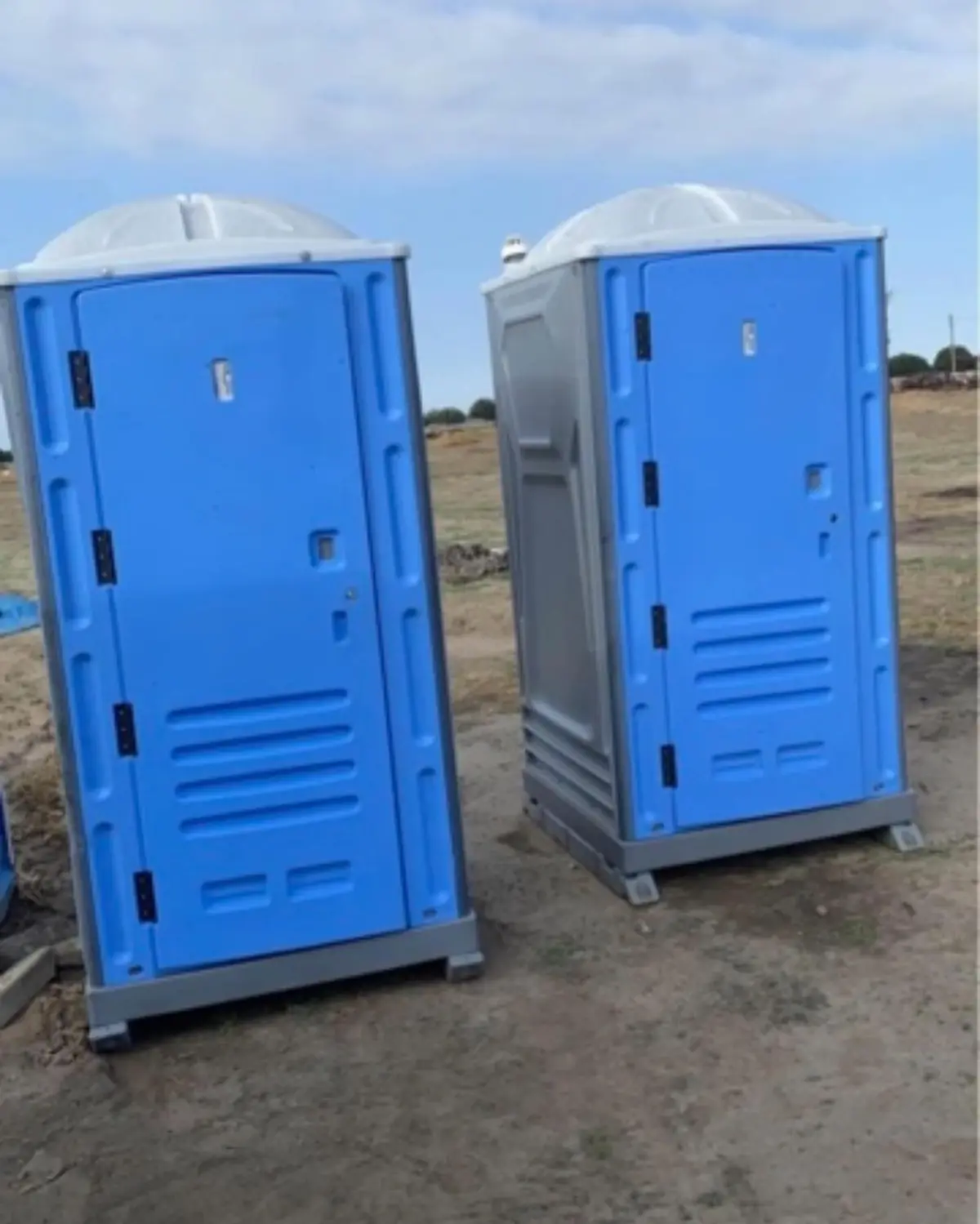
What are the OSHA porta potty requirements for construction?
OSHA rule 29 CFR 1926.51(c) requires 1 toilet for 20 or fewer workers. A crew of 20 or more needs 1 toilet seat and 1 urinal per 40 workers. A crew of 200 or more needs 1 toilet seat and 1 urinal per 50 workers. OSHA calls this list Table D-1.
Here is Table D-1 as written in 29 CFR 1926.51:
| Number of employees | Minimum number of facilities |
|---|---|
| 20 or less | 1 |
| 20 or more | 1 toilet seat and 1 urinal per 40 workers |
| 200 or more | 1 toilet seat and 1 urinal per 50 workers |
The same section says that under temporary field conditions, at least one toilet facility must be available. Job sites without a sanitary sewer may use chemical toilets, recirculating toilets, combustion toilets or privies, unless local codes say otherwise. A portable chemical toilet is the usual choice.
The rule counts employees, not people on site for a day. Count every worker who will use the toilets during a normal shift, including subcontractors if your contract says you provide sanitation.
How many porta potties does OSHA require for my crew?
Divide your crew size by 40, round up, and you get the number of toilet seats and urinals OSHA requires for 21 to 199 workers. A crew of 60 needs 2 seats and 2 urinals. At 200 workers or more, divide by 50 instead. Rounding up is the safe reading.
| Workers on site | Math | OSHA minimum |
|---|---|---|
| 8 | 20 or fewer | 1 toilet |
| 20 | 20 or fewer | 1 toilet |
| 35 | 35 ÷ 40 = 0.9, round up to 1 | 1 seat + 1 urinal |
| 60 | 60 ÷ 40 = 1.5, round up to 2 | 2 seats + 2 urinals |
| 120 | 120 ÷ 40 = 3 | 3 seats + 3 urinals |
| 250 | 250 ÷ 50 = 5 | 5 seats + 5 urinals |
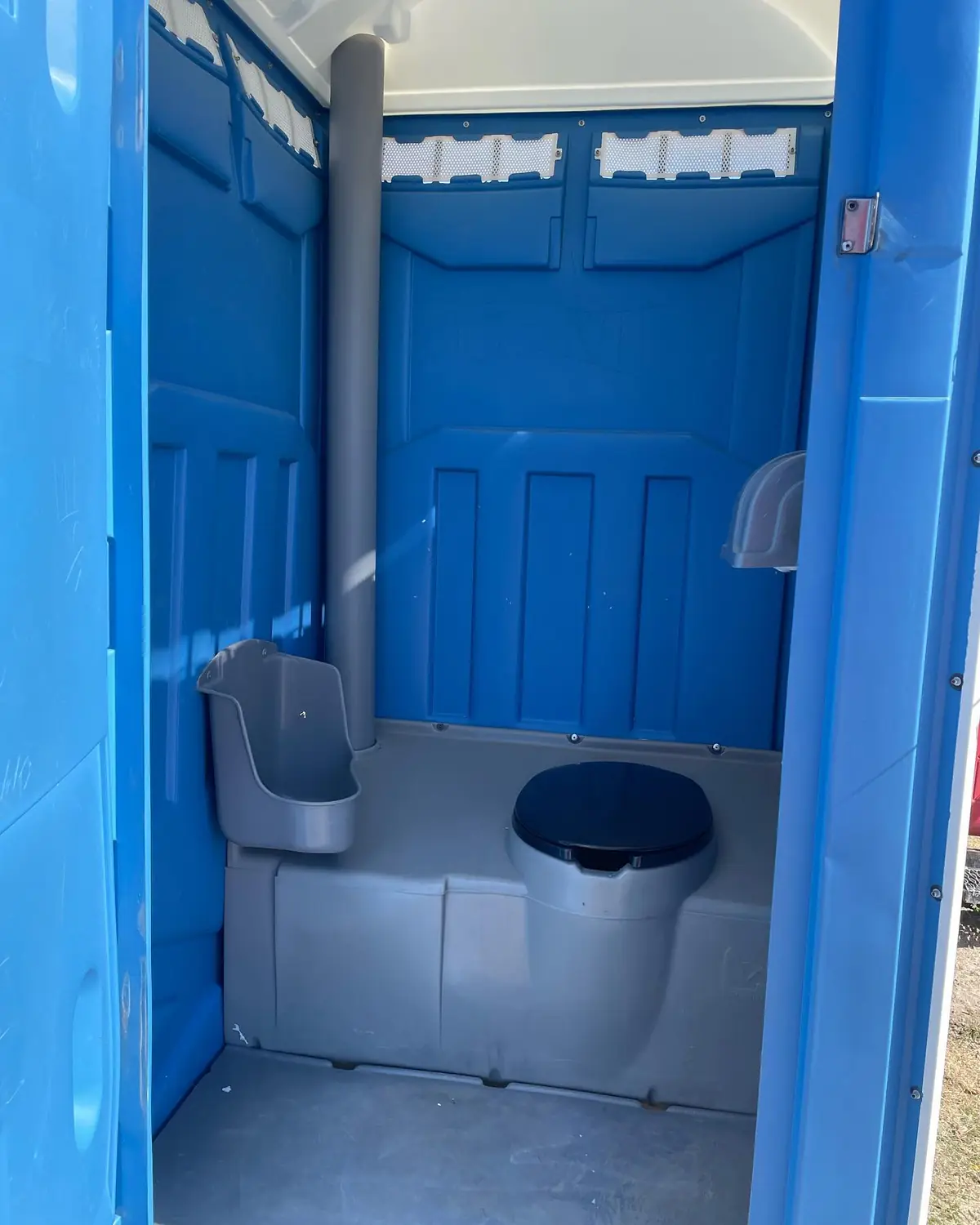
Our standard porta potty has one toilet seat and one urinal inside. Some safety officers count that unit as one seat and one urinal; others count it as one facility. Ask the person who signs off on your site plan how they count combined units.
Ready to book or price it out?
A local dispatcher answers Mon–Sat, 7 a.m.–7 p.m.. Have your ZIP, dates and headcount ready, and you get an itemized price on the call.
Legal minimum vs. what actually works
The OSHA minimum and a comfortable job site are two different numbers. OSHA allows 1 toilet for up to 20 workers, but one unit serviced weekly fills fast at that load. Our service advice is about 10 workers per unit on a 40-hour week, or a second weekly service.
| Crew size (40-hour week) | OSHA minimum (law) | Our recommendation (not law) |
|---|---|---|
| 1–10 | 1 toilet | 1 unit, weekly service |
| 11–20 | 1 toilet | 2 units weekly, or 1 unit serviced twice a week |
| 35 | 1 seat + 1 urinal | 4 units weekly, or fewer units with extra service |
| 60 | 2 seats + 2 urinals | 6 units weekly, or fewer units with extra service |
The recommendation column is about tank capacity and cleanliness, not legal compliance. A 60-gallon tank used by too many people overflows before the next pump-out, and workers stop using it.
Longer shifts, hot weather and crews that drink a lot of water all push the numbers up. Weekly service details and pricing are on the construction porta potty rental page.
Does OSHA require a hand wash station on a job site?
OSHA rule 1926.51(f)(3) says lavatories shall be made available in all places of employment, with running water, hand soap and individual towels. On most job sites that means a portable hand wash station next to the toilets. Crews handling paint, coatings, herbicides or insecticides need washing facilities close to the work.
The lavatory rule lists hot and cold running water, or tepid running water. A foot-pump hand wash station supplies running water, soap and paper towels, but the water is not heated. Ask your safety officer how your company meets the water temperature language.
Section 1926.51(f)(1) adds a separate rule. Workers applying paints, coatings, herbicides or insecticides, or doing other work with harmful contaminants, need washing facilities near the worksite that let them remove those substances.
Washing facilities must also be kept sanitary. That is why our wash stations get fresh water, soap and towels at each weekly service.
Who is exempt? Mobile crews and short jobs
OSHA exempts mobile crews that have transportation readily available to nearby toilets. In a 2002 interpretation letter, OSHA said nearby generally means less than 10 minutes away. A crew that works at one project for days or weeks is not a mobile crew and needs toilets on site.
The exemption is in section 1926.51(c)(4). The OSHA interpretation letter of June 7, 2002 describes mobile crews as workers who continually or frequently move from jobsite to jobsite, daily or hourly. Road crews, utility crews and service techs often fit that description.
The same letter says toilets that take too long to reach are not available. The access must equal what fixed-site workers get. A truck parked on site with keys does not help if the nearest public restroom is 20 minutes away.
For crews that move during the day, a towable porta potty or long-term rental keeps a toilet with the crew. A short job still needs a toilet if the crew stays put.
What are OSHA's toilet rules for farms?
OSHA rule 29 CFR 1928.110 covers farms with 11 or more hand laborers in the field on any day. The farm needs 1 toilet and 1 handwashing facility for every 20 workers or fraction of 20, located within a one-quarter-mile walk of each worker. Field work of 3 hours or less, including travel, is exempt.
| Hand laborers in the field | Toilets | Handwashing facilities |
|---|---|---|
| 10 or fewer | Rule does not apply | Rule does not apply |
| 11–20 | 1 | 1 |
| 21–40 | 2 | 2 |
| 41–60 | 3 | 3 |
The rule in 29 CFR 1928.110 also says toilets and handwashing facilities should be close together. When terrain makes the quarter-mile rule impossible, they go at the closest point a vehicle can reach.
Facilities must be kept to public health sanitation standards. Seasonal crews usually rent on a 28-day cycle with weekly service.
What about permanent workplaces? (OSHA 1910.141)
Permanent workplaces fall under OSHA 29 CFR 1910.141, not the construction rule. That rule uses Table J-1, which requires 1 toilet for 1 to 15 workers, 2 for 16 to 35, and 3 for 36 to 55. Portable toilets often fill in while a building's restrooms are closed for repair.
| Employees | Minimum water closets |
|---|---|
| 1–15 | 1 |
| 16–35 | 2 |
| 36–55 | 3 |
| 56–80 | 4 |
| 81–110 | 5 |
| 111–150 | 6 |
| Over 150 | 1 more for each extra 40 employees |
Rule 29 CFR 1910.141 also calls for separate toilet rooms for each sex in general industry, and it has its own mobile crew exemption. Warehouses, plants and offices with a restroom outage should ask their safety lead which numbers to plan for.
This page explains the rules; it is not legal advice. Confirm your plan with your safety officer, general contractor or permit office.
Common questions
Does OSHA say how often a job site porta potty must be cleaned?
OSHA's construction rule sets how many toilets a site needs, not a pumping schedule. Weekly service is the industry norm for a 28-day rental. We add a second weekly visit when one unit serves more than about 10 workers.
Do job site porta potties have to be wheelchair accessible?
The 2010 ADA Standards exempt portable toilets used only by construction workers, under section 203.2. If the public or non-construction staff will use the toilets, accessible units may be required. A wheelchair-accessible unit also helps an injured worker.
How far can the porta potty be from where the crew works?
The construction rule names no fixed distance. OSHA's 2002 interpretation says toilets should be reachable in under 10 minutes so workers can use them when needed. On farms, rule 1928.110 sets a quarter-mile walk.
Is a crew of one or two people at a house still required to have a toilet?
OSHA requires at least 1 toilet for 20 or fewer workers, so a small crew still counts. Some homeowners let the crew use a house bathroom by written agreement. If the bathroom is torn out, rent a unit.
Who has to provide the porta potty, the general contractor or the subcontractor?
OSHA puts the duty on each employer, but on most sites the general contractor supplies toilets for everyone in the contract. Put the sanitation line in writing so no crew is left without a toilet.