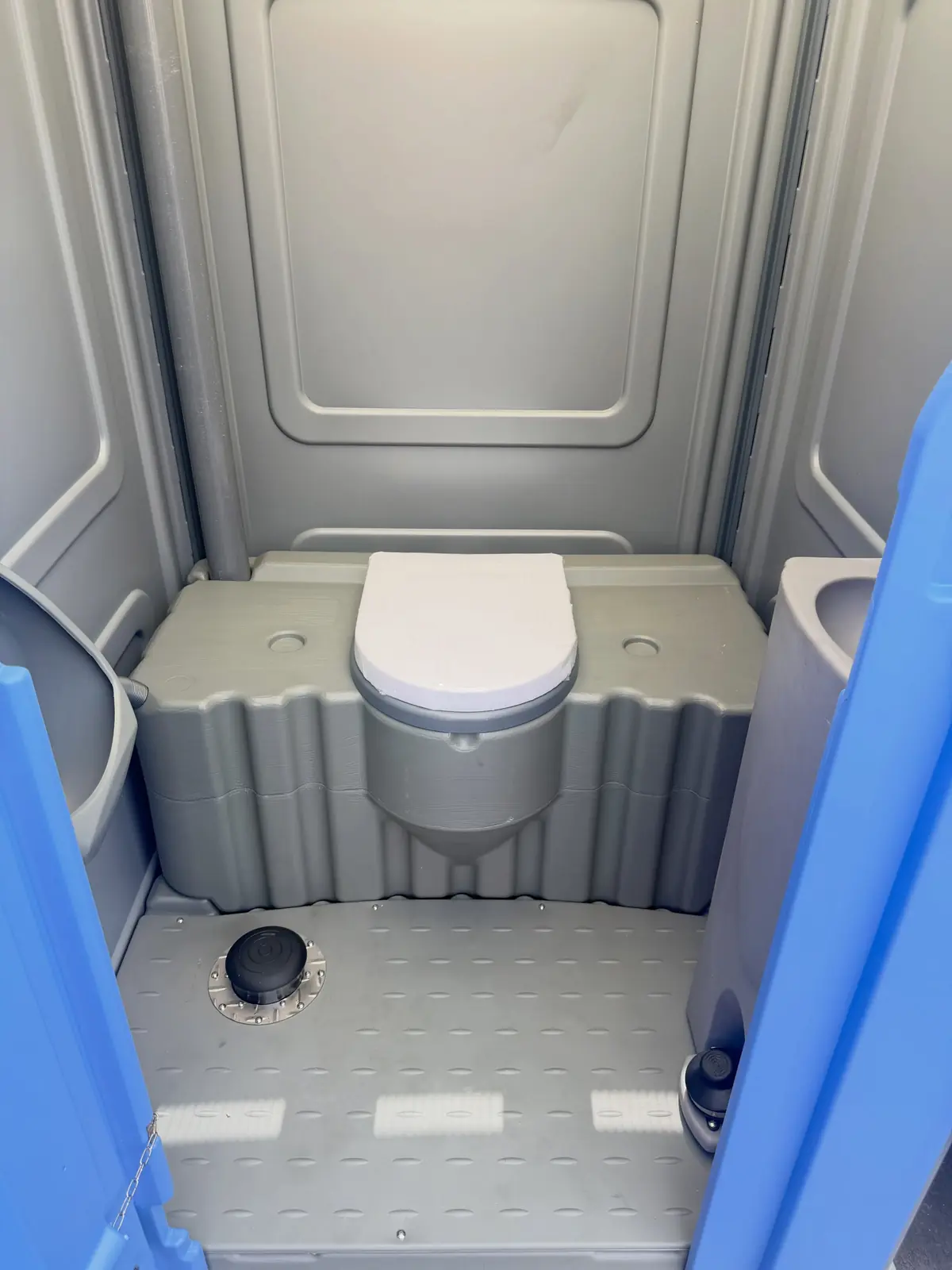
What makes a porta potty wheelchair-accessible?
A wheelchair-accessible porta potty has a ground-level floor with no step, a 32-inch wide door opening, handrails and more than 16 square feet of floor. Our handicap porta potty is the PolyJohn Comfort XL, which gives a wheelchair room to roll in, turn and close the door.
- No step: the floor sits at ground level, so a wheelchair rolls straight in.
- 32-inch door opening: wide enough for a standard wheelchair or walker.
- Handrails at 33 inches: for steady transfers to and from the seat.
- 16+ square feet of floor: room to turn around inside.
- Toilet paper and sanitizer: stocked at delivery and each service.
The same room helps more than wheelchair users. Parents with small kids, caregivers helping someone, and guests with walkers or canes all find it easier to use.
Tech specs: PolyJohn Comfort XL
The PolyJohn Comfort XL wheelchair-accessible porta potty stands 91 inches tall, 62 inches wide and 62 inches deep. The Comfort XL has a 32-inch door opening, 33-inch handrails and a 33-gallon holding tank. These are manufacturer figures for the unit itself, not the space around it.
| Spec | PolyJohn Comfort XL |
|---|---|
| Height | 91 in |
| Width | 62 in |
| Depth | 62 in |
| Door opening | 32 in wide |
| Floor | Ground level, no step; 16+ sq ft |
| Handrails | 33 in high |
| Holding tank | 33 gallons |
Full manufacturer details are on the PolyJohn Comfort XL spec page. The holding tank is about half the size of a standard unit's 60 gallons, so busy events may need an extra service.
How many accessible units does an event need?
Under section 213.2 of the 2010 ADA Standards, at least 5% of portable toilets in each cluster must be accessible, and never fewer than 1. A cluster of 7 units needs 1 accessible unit. A cluster of 21 to 40 units needs 2 accessible units.
Read the rule in the 2010 ADA Standards, section 213.2. The rule counts each group of toilets in one spot as its own cluster. Two clusters of 10 units each need 1 accessible unit in each cluster, not 1 total.
| Units in the cluster | Accessible units (5%, min. 1) |
|---|---|
| 1 to 20 | 1 |
| 21 to 40 | 2 |
| 41 to 60 | 3 |
| 61 to 80 | 4 |
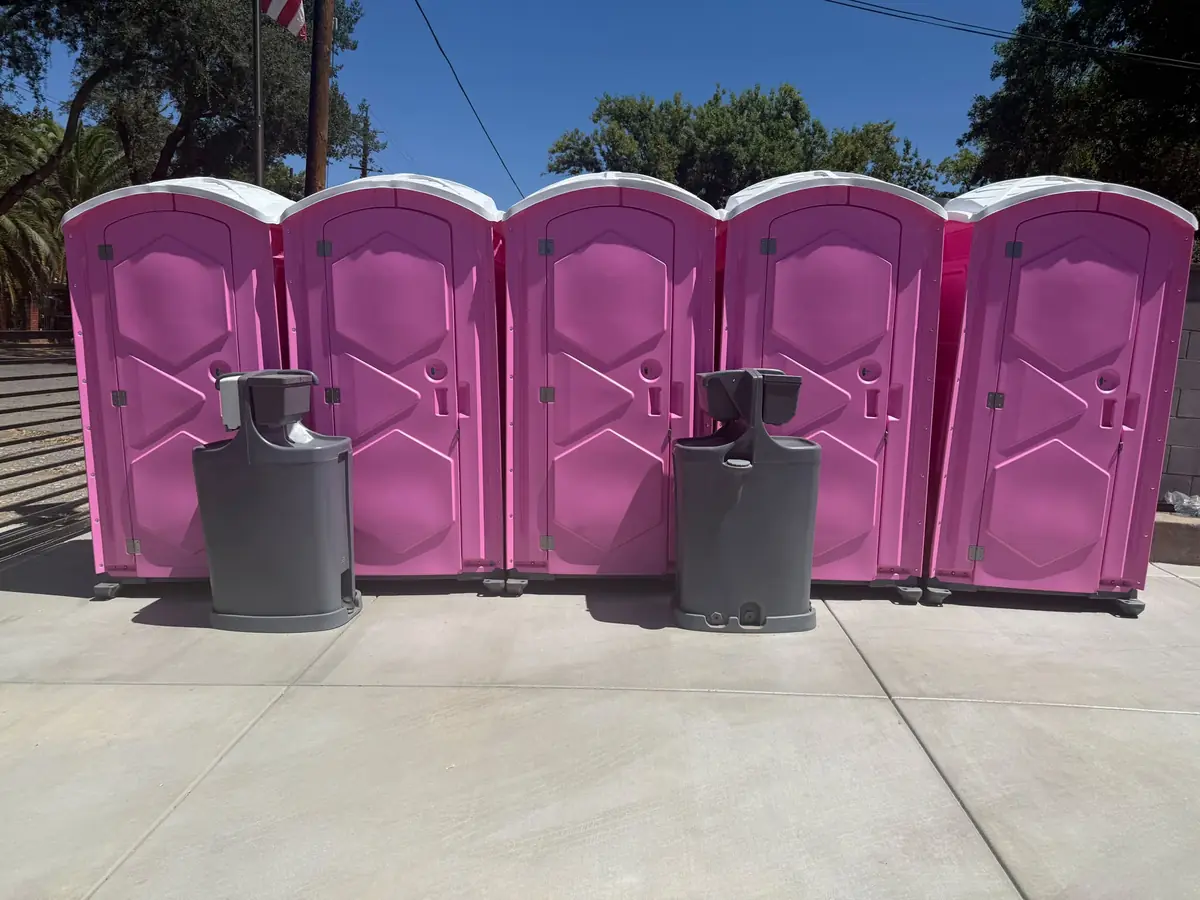
An accessible unit also needs a clear turning space: a 60-inch diameter circle or a T-shaped space. Portable toilets used only by construction workers are not covered by section 213. Our porta potty calculator adds the accessible count for you.
Your venue, permit office or event safety officer has the final say. We don't give legal advice.
Will an accessible unit fit through my gate?
A wheelchair-accessible unit is 62 inches wide, so the path needs about 66 inches of clear width. Most backyard gates are too narrow. Plan to place the accessible unit on a driveway, parking lot or lawn edge within about 15 feet of where the truck parks.
Placement matters as much as the unit. A wheelchair cannot cross deep gravel, thick grass or mud. Set the unit on pavement or firm, level ground, and keep the path to it smooth and free of cords and steps.
Leave a 60-inch circle of flat space in front of the door so a wheelchair can turn. Tell dispatch about slopes, soft lawns or gate codes before delivery. See our placement guide for more.
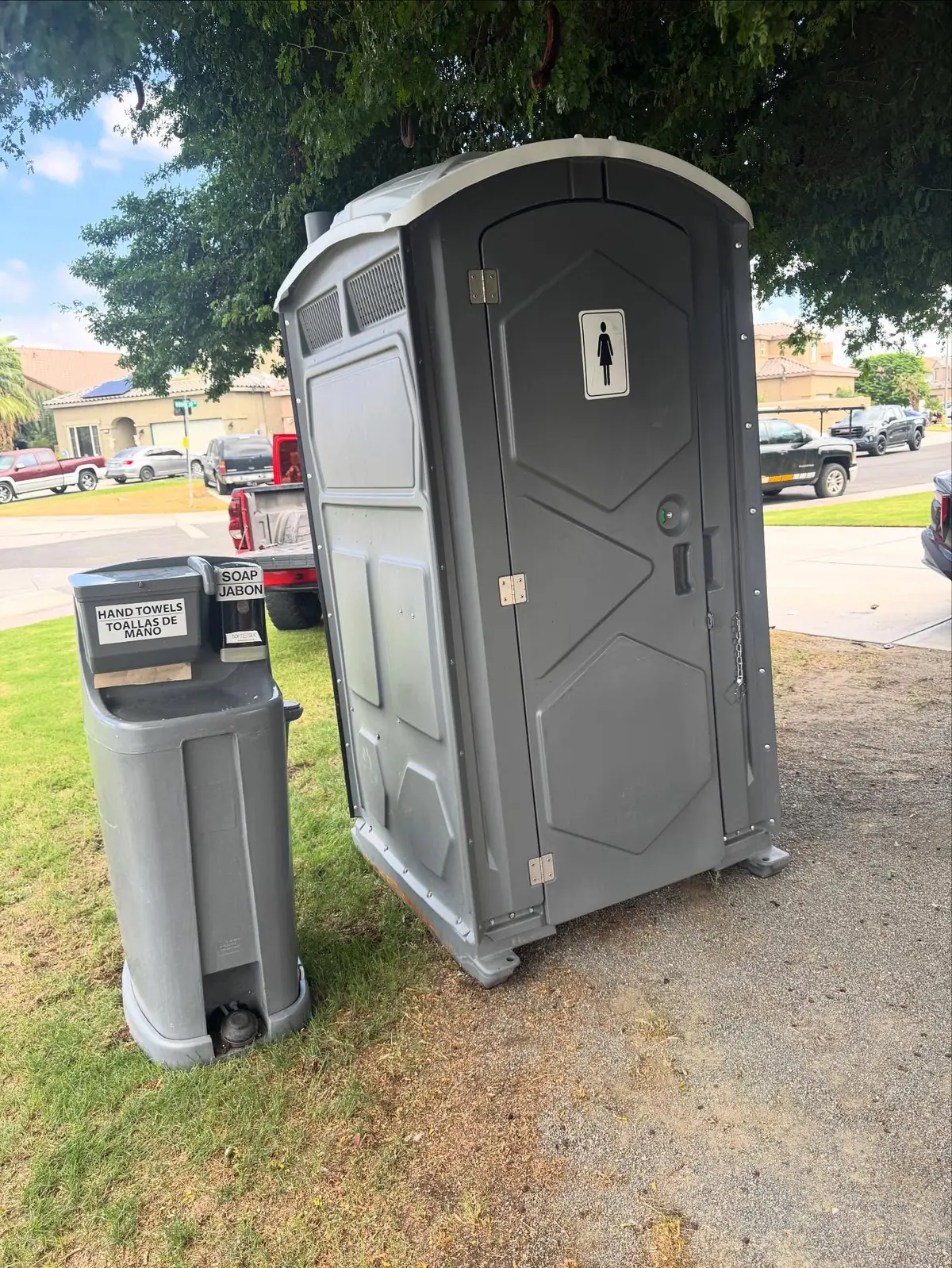
Is a wheelchair-accessible unit the right choice?
A wheelchair-accessible unit is the right choice for any public event, church service, park gathering or family party with a wheelchair or walker user. An accessible unit is the wrong choice as the only toilet for a large crowd, since its 33-gallon tank fills about twice as fast.
Good fit
- Public events, festivals and community events
- Church services, graduations and reunions with older guests
- Homes where a family member uses a wheelchair during a remodel
- Parents with strollers or small kids
Wrong choice
- Narrow sites: the 62-inch footprint will not pass a normal gate.
- Main toilet for a crowd: pair it with standard units instead.
- Crew-only job sites: a standard unit costs less and holds more.
- Uneven, muddy ground: a wheelchair still cannot reach the door. Fix the path first.
The unit is wheelchair-accessible by design. Whether a site meets the ADA also depends on the path, parking and setup around it.
Accessible unit vs. standard unit: what are the trade-offs?
A wheelchair-accessible porta potty costs $70 more than a standard unit for an event and takes about twice the floor space. In exchange, the accessible unit has no step, a 32-inch door and handrails. The standard unit holds 60 gallons; the accessible unit holds 33.
| Wheelchair-accessible (Comfort XL) | Standard (PJN3) | |
|---|---|---|
| Event price | From $235 | From $165 |
| 28-day price | From $245 + delivery | From $175 + $75 delivery |
| Footprint | 62 x 62 in | 43.5 x 47 in |
| Clear path needed | About 66 in | 48 in |
| Entry | Ground level, no step | Small step up |
| Holding tank | 33 gallons | 60 gallons |
| Urinal | No | Yes |
Ready to book or price it out?
A local dispatcher answers Mon–Sat, 7 a.m.–7 p.m.. Have your ZIP, dates and headcount ready, and you get an itemized price on the call.
What does a handicap porta potty rental in Dayton cost?
A handicap porta potty rental in Dayton starts at $235 for an event of 1 to 3 days, with Zone 1 delivery and pickup included. A 28-day rental starts at $245 per cycle plus a one-time delivery charge, with weekly service. Prices are starting estimates before tax.
Outside Zone 1, add $40 for Zone 2 or $95 for Zone 3. Same-day delivery adds a $50 rush fee. Extra service visits are $45. Weekend events go out Friday and come back Monday at no extra charge.
Tax-exempt churches and public agencies can send a certificate to drop sales tax. The cost guide shows sample quotes line by line.
How is the accessible unit serviced?
A wheelchair-accessible unit on a 28-day rental is serviced once a week. Each visit pumps the 33-gallon tank, scrubs the floor, rails and seat, adds deodorizer, and restocks paper and sanitizer. At busy events, book a $45 mid-event service because the smaller tank fills sooner.
Event units arrive clean and stocked. From November through March, we add non-toxic antifreeze at every service. If the site is locked on service day, text dispatch the gate code.
Common questions
Is this unit ADA approved?
The Comfort XL is built to be wheelchair-accessible: no step, a 32-inch door, handrails and room to turn. Full ADA conformance also depends on the level path, turning space and setup at your site, so check with your venue or permit office.
Is a handicap unit just a slight upcharge?
A wheelchair-accessible unit starts at $235 for an event, which is $70 more than a $165 standard unit. On a 28-day rental, it starts at $245 versus $175 for a standard unit.
Can I get one handicap unit and one regular unit?
Mixing units is common for church services, picnics and parties. One accessible unit plus one or more standard units arrive on the same truck, with one delivery line on the quote.
How wide is the door on a handicap porta potty?
The door opening on our Comfort XL is 32 inches wide. The unit itself is 62 inches wide and 62 inches deep, with more than 16 square feet of floor inside.
Do construction sites need a handicap porta potty?
Portable toilets used only by construction workers are not covered by the ADA toilet rules in section 213. If the public or a worker who uses a wheelchair needs access, add an accessible unit.
Can I swap a standard unit for an accessible one later?
You can swap units by calling or texting dispatch. We pick up the standard unit and drop the accessible unit on the next route, usually the next business day.
Where should the accessible unit go?
Place the accessible unit on firm, level ground with a smooth path from parking or seating. Leave a 60-inch circle of flat space at the door, and keep cords, gravel and curbs out of the way.