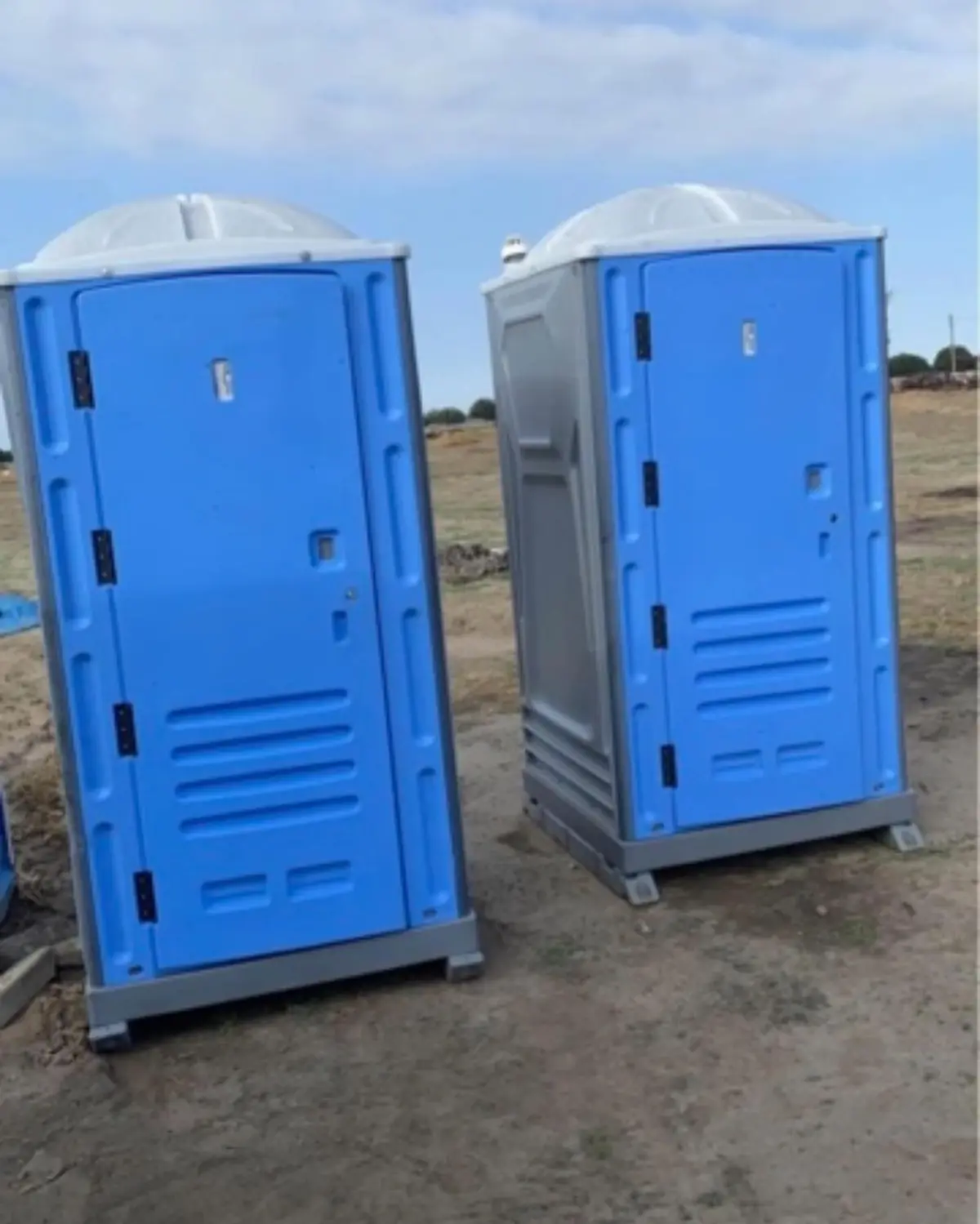
How many job site toilets does OSHA require?
OSHA 29 CFR 1926.51(c) Table D-1 requires 1 toilet for 20 or fewer workers. At 20 or more workers, a job site needs 1 toilet seat and 1 urinal per 40 workers. At 200 or more workers, the ratio becomes 1 seat and 1 urinal per 50 workers.
| Number of employees | Minimum facilities (Table D-1) |
|---|---|
| 20 or fewer | 1 toilet |
| 20 or more | 1 toilet seat and 1 urinal per 40 workers |
| 200 or more | 1 toilet seat and 1 urinal per 50 workers |
Source: OSHA 29 CFR 1926.51, paragraph (c), Table D-1. Each standard PolyJohn PJN3 job site toilet has a seat and a built-in urinal, so one unit covers one seat and one urinal on the chart.
The law sets the floor, not the comfort level. Our own planning rule is separate from OSHA: weekly service handles about 10 workers per unit on a 40-hour week. Past 10 workers per unit, add a unit or a second weekly service.
| Crew size (40-hour week) | OSHA minimum | Our recommendation |
|---|---|---|
| 1–10 | 1 toilet | 1 unit, weekly service |
| 11–20 | 1 toilet | 2 units, or 1 unit with 2 services a week |
| 21–40 | 1 seat + 1 urinal | 3–4 units, weekly service |
Confirm the count with your safety officer or general contractor. We help with sizing, but we don't give legal advice. The OSHA porta potty requirements guide covers the full rule.
Do construction sites need hand wash stations?
OSHA 1926.51(f) requires washing facilities on a job site where workers handle paints, coatings, herbicides or other harmful contaminants. A PolyJohn Bravo hand wash station holds 22 gallons of fresh water and is rated at nearly 350 uses per fill. A 28-day hand wash station rents from $150 with weekly refill.
Crews doing demolition, painting, roofing tear-off or concrete work get dirty hands fast. Hand sanitizer inside a standard unit does not remove grime or chemicals. A freestanding hand wash station with foot pumps, soap and paper towels does.
Each weekly visit refills fresh water, empties the 24-gallon gray-water tank and restocks soap and towels. Set the station a few steps from the toilet so workers use both on one trip.
Read paragraph (f) of OSHA 29 CFR 1926.51 with your safety lead to decide whether your trade needs one.
Crew starting soon?
A local dispatcher answers Mon–Sat, 7 a.m.–7 p.m.. Have your ZIP, dates and headcount ready, and you get an itemized price on the call.
What does weekly job site toilet service include?
Weekly service on a construction porta potty includes 5 tasks: pump the 60-gallon tank, scrub and wash the inside, refill the blue deodorizer, restock toilet paper and refill hand sanitizer. You get a service slip or text after each visit, so you know the unit was cleaned.
Service day stays the same each week when the route allows. If the site gate is locked that day, text dispatch the gate code or move the visit by text.
When one weekly visit is not enough
High-traffic sites fill a tank faster. Signs you need more service: the tank looks over half full by midweek, paper runs out, or crews complain. An extra service visit costs $45 in Zones 1–2. Order one by phone or text, and it usually happens the next business day. For a standing second visit each week, ask dispatch to add it to your schedule.
Keep the service slips or texts. They give you a dated record if an inspector asks.
How does construction porta potty rental billing work?
Construction porta potty rental in Dayton starts at $175 per 28-day cycle plus a one-time $75 delivery and pickup, with weekly service included. Billing runs on 28-day cycles, not calendar months. The cycle renews until you call or text for pickup, and billing stops the day you request it.
| Line on your quote | Starting price (before tax) |
|---|---|
| Standard unit, per 28-day cycle | $175 |
| Delivery and pickup (one time) | $75 |
| Weekly service | Included |
| Lock hasp | Free on request |
| Winter antifreeze (Nov–Mar) | Included |
| Zone 2 / Zone 3 travel | +$40 / +$95 |
| Same-day rush (if needed) | $50 |
A short job still pays the first full cycle, because delivery and pickup cost the same for 3 days or 28. After the first cycle, you are never charged for a cycle you did not use. Nothing gets added after you book unless you add service.
Monthly invoicing for contractors
Approved contractors can get monthly invoicing across all their jobs. Everyone else pays by Visa, Mastercard, Amex or Discover by phone, or through a secure text or email pay link. Tax-exempt jobs send the certificate before delivery. Full detail is on the porta potty rental cost guide.
Where should the porta potty go on a construction site?
Place a job site toilet on firm, level ground within about 15 feet of where the service truck can park. Keep it near the work but out of the path of equipment and deliveries. The gate or path needs at least 48 inches clear, because a standard unit is 43.5 inches wide.
- Near the crew: close enough that workers do not walk off site, but away from the dumpster pad and crane swing.
- Truck access: the pump truck returns every week, so keep the spot reachable after the site fills with material.
- Mark the spot: a cone, flag or chalk X works, or text dispatch a photo. Nobody needs to be on site.
- Tell dispatch: low wires, soft ground, locked gates, gate codes and trench work.
Locks on job site units
A padlock hasp is free on request. We leave the key or combination wherever you ask, such as the site box or under the unit.
Wright-Patterson AFB and industrial sites
On Wright-Patterson AFB jobs, the contractor arranges gate access and driver badging. Tell dispatch ahead so the delivery and every weekly service can get through. Plants and secured industrial sites work the same way: share check-in rules, escort needs and gate hours when you book.
More tips are in the porta potty placement guide.
Can one account cover several sites or a crew that moves?
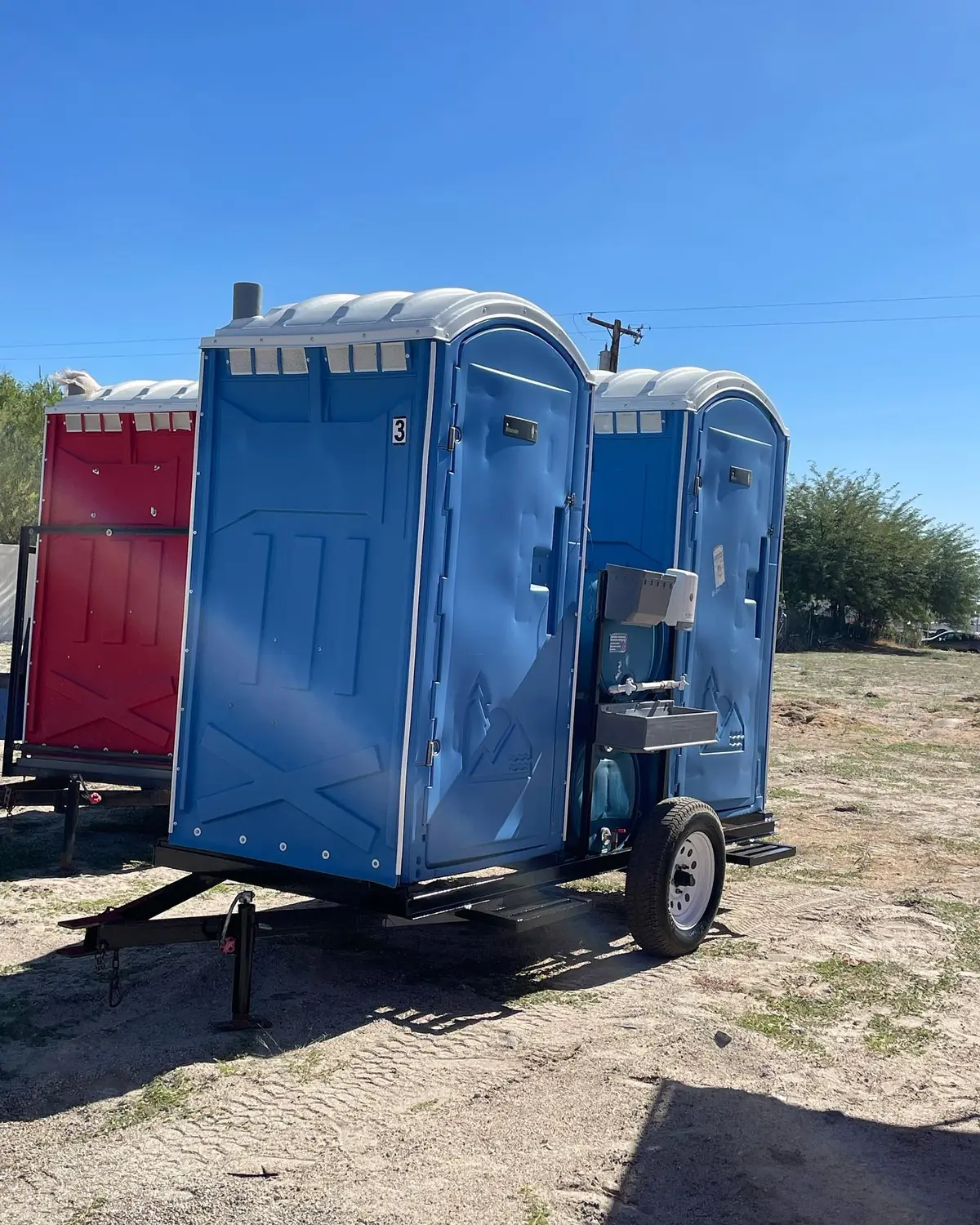
One account can cover every job you run within about 80 miles of Dayton. Each site gets its own unit, its own weekly service day and its own line on the invoice. For road, utility, landscaping or farm crews that move daily, a towable porta potty on a single-axle trailer moves with the crew.
Tell dispatch each address, the start date and the crew size. When a phase ends, call or text for pickup at that site, and its billing stops that day while your other sites keep running.
Towable units are quoted by phone because hitch, trailer and service plans vary by crew.
What happens to job site toilets in an Ohio winter?
Dayton winters bring average January lows near 20°F, cold enough to freeze a toilet tank. From November through March, every service adds non-toxic antifreeze or brine to each job site toilet at no extra charge. The hand wash station needs extra care, because its fresh water can freeze too.
Keep the door shut and the vent clear of snow. Shovel a path so the pump truck and the crew can reach the unit. If a hand wash station freezes, crews can switch to sanitizer until the next service.
Read winter porta potty rental in Ohio for cold-weather tips.
Our supplier didn't show up. Can you deliver today?
Same-day job site delivery is available Monday through Saturday when you call by 12:00 noon in Zones 1 and 2. The dispatcher confirms on the call whether a truck can make it. Same-day adds a flat $50 rush fee, shown as its own line on the quote.
Have the site address or ZIP code, the drop spot and any gate code ready. The unit arrives cleaned and stocked, and weekly service starts from there. Calls after noon go on the next morning's route.
See same-day porta potty rental for what the dispatcher asks.
Common questions
Even if I only keep it three days, do I pay for the full 28 days?
A short job pays the first 28-day cycle, from $175 plus the $75 delivery and pickup. Delivery, pickup and setup cost the same for 3 days or 28. After the first cycle, billing stops the day you call or text for pickup.
Is a construction unit different from an event porta potty?
The unit is the same standard PolyJohn PJN3 with a seat, urinal and sanitizer. The difference is the plan. A job site rental runs on 28-day cycles with weekly service. An event rental is a flat rate for 1–3 days with no mid-event service.
How many porta potties do I need for 25 workers?
OSHA Table D-1 calls for at least 1 toilet seat and 1 urinal per 40 workers once a crew reaches 20, so 1 standard unit meets the minimum. For comfort, plan 2–3 units or add a second weekly service. Confirm with your safety officer.
Does the lock cost extra?
A padlock hasp is free on any job site unit. Ask for it when you book, and tell dispatch where to leave the key or combination, such as a lockbox or under the unit. Tell us the code if you use your own lock.
Do I have to call for pickup, or does it leave on its own?
Call or text dispatch when the job is done. A 28-day rental renews until you ask for pickup, and billing stops on the day you make that request. Clear the path to the unit so the truck can reach it.
Can you put our company name on the invoice?
Every invoice can show your company name, job name and site address for reimbursement. Approved contractors can also get one monthly invoice that covers every site. Ask dispatch to set that up after your first order.
Can the toilet be serviced twice a week?
A second weekly service is available for busy sites. Each extra visit costs $45 in Zones 1–2. We suggest it when one unit serves more than about 10 workers on a 40-hour week, or when the tank is over half full by midweek.